
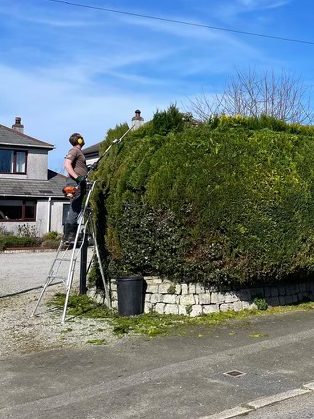
Hedges are one of the most overlooked parts of a garden – until they’re not. A well-kept hedge frames a property, adds privacy, and genuinely lifts the whole look of an outdoor space. A neglected one can spread onto paths, block light, upset neighbours, and become significantly harder and more expensive to deal with the longer it’s left. After twelve years trimming hedges across Cornwall – from terraced gardens in Penzance and St Ives to large rural properties up towards Bodmin and Launceston – here’s everything you need to know about when to cut, how often, and what to watch out for down here in Cornwall specifically.
When Is the Best Time to Trim Hedges in Cornwall?
The general rule across the UK is that the main hedge trimming season runs from late August through to February – after nesting season has ended and before the following spring’s breeding activity begins. Within that window, the two best times to trim are:
Late August to October: The main growing season is winding down, so a trim at this point keeps it looking neat for longer. Cutting now also tidies up the summer’s growth before winter sets in.
February to early March: A light tidy before the new growing season begins. This is particularly good for formal hedges that you want looking sharp heading into spring.
What about summer? Some hedges – particularly fast-growing species like privet, leylandii, and laurel – may need a light trim in June or July to keep them in check. This is where nesting season becomes important (see below). A light tidy to keep the shape is generally fine during summer; a hard cut that removes significant growth and disturbs nesting habitat is what to avoid.
In Cornwall specifically, the mild climate means hedges often continue growing later into the year than in other parts of the UK. It’s not unusual to still be trimming into November when hedges have had a late flush of growth.
What Are the Rules About Cutting Hedges During Nesting Season?
This is one of the most important things any responsible gardener in Cornwall needs to know – and it’s something I always check before putting a hedge trimmer anywhere near an established hedge between March and August.
Under the Wildlife and Countryside Act 1981, it is a criminal offence to intentionally damage or destroy the nest of any wild bird while it is being built or is in use. This applies to hedges, trees, shrubs, and any other garden vegetation where birds may be nesting. It applies to homeowners as much as it does to professional gardeners.
Nesting season in the UK runs from approximately March to August – though in Cornwall’s mild climate, some species nest earlier or later than the national average.
This does not mean you cannot touch your hedges between March and August. It means you need to check carefully before cutting. The practical guidance is:
- Always inspect the hedge closely before trimming – look and listen for signs of nesting activity.
- If you find an active nest with eggs or chicks, leave that section alone until the nest is no longer in use.
- Light trimming that doesn’t disturb nesting habitat is generally acceptable.
- Hard cutting that removes large amounts of cover during peak nesting season is where the risk lies.
When I’m working on hedges between March and August, I always inspect before cutting and work around any active nests. It’s not just the law – it’s the right thing to do. Cornwall is home to some brilliant garden birds, including robins, wrens, dunnocks, and blackbirds, and a bit of patience goes a long way.
How Often Should You Trim Hedges?
It depends entirely on the species, the look you want, and how fast your particular hedge is growing. Here’s a rough guide:
Slow-growing hedges (yew, box, beech, hornbeam): Once a year is usually sufficient – late summer or early autumn is the best time.
Medium-growing hedges (hawthorn, privet, holly): Twice a year – once in early summer (if nesting checks allow) and again in late summer or early autumn.
Fast-growing hedges (leylandii, laurel, griselinia): Up to three times a year to keep them looking managed. Leylandii in particular can grow up to a metre a year in Cornwall’s mild, wet climate – if left unchecked for a season, they become a significant job.
One important point about Cornwall’s climate: the combination of mild temperatures and high rainfall means hedges here consistently grow faster and for longer than in most other parts of the UK. If you’ve moved to Cornwall from elsewhere and you’re surprised at how quickly your hedges are filling out – that’s completely normal, and it’s worth adjusting your cutting schedule accordingly.
What Height and Shape Should a Hedge Be?
For most domestic hedges, a slightly tapered shape – wider at the base than at the top – is best for long-term health. It allows light to reach the lower branches, which prevents the base from becoming bare and woody over time. A hedge that’s been cut flat or wider at the top will gradually thin out at the bottom and become difficult to fix.
Height is a personal preference, but a few practical points:
- Hedges along boundaries with public paths or roads need to be kept clear of footways – your local council can require you to cut them back if they’re blocking access.
- Hedges between neighbouring properties can sometimes become a source of dispute – if you’re sharing a boundary hedge, it’s worth talking to your neighbour before making significant changes to its height or shape.
- If a hedge has been left to grow extremely tall over many years, reducing its height significantly needs to be done carefully and gradually – taking too much off a very old hedge in one go can cause it to fail.
Common Hedge Problems in Cornwall
Bare patches and die-back: Often caused by cutting too hard, cutting too high at the top without light reaching the base, or root competition from nearby trees. Bare patches in leylandii, unfortunately, won’t regenerate – that species doesn’t reshoot from old wood – which is why keeping on top of it matters.
Overgrowth and encroachment: Hedges left too long can spread significantly onto paths, driveways, or neighbouring land. In severe cases, this needs a phased reduction over two or three seasons rather than a single hard cut.
Pest and disease issues: Box blight, vine weevil, and aphid damage are all increasingly common in Cornish gardens. Regular trimming keeps hedges healthier overall, and any signs of disease are caught earlier when the hedge is being maintained properly throughout the year.
Root spread: Some hedge species, particularly privet and hawthorn, have aggressive root systems that can compete with nearby plants or even affect paths and drives over time. Worth being aware of when planning new hedges close to hard surfaces.
When Should You Hire a Professional Hedge Trimmer in Cornwall?
Hedge trimming looks simple, but it can be physically demanding, time-consuming, and genuinely risky if you’re working at height or with a large overgrown hedge on a slope. There’s also the nesting season knowledge required to do it legally and responsibly.
It’s worth calling in a professional if:
- Your hedge has grown significantly and needs to be brought back under control.
- You’re not confident working at height or with powered tools.
- You’re unsure whether there’s nesting activity and want someone to check and manage it properly.
- You want a regular schedule throughout the year, so the hedge never gets ahead of you.
- The hedge is large, long, or on a slope – the kind of job that takes a full day and the right equipment to do properly.
I offer hedge trimming right across Cornwall – from a one-off tidy to a regular yearly or twice-yearly schedule. I always check for nesting activity before cutting, work to the right height and shape for your hedge’s species and age, and clear all cuttings before I leave.
If you’d like a chat about your hedges, give me a call or drop me a message. No pressure, no obligation.

Leave a Reply